


Alex's Fishing Column 21 May 2026
- May 22
- 3 min read
Judging by all the reports I’ve received about the great fishing happening during this year’s Runoff, it’s clear to me that most anglers are using soft plastic lures.
That’s not to say that perennial hard-body lures like Bombers, Classics and Reidys are not catching their fair share of barramundi, but the popularity of softies has literally soared over the past 20 years and, nowadays, serious barra anglers will carry at least as many soft plastics with them as they will hard-body lures.
In the early days of their evolution, softies occupied only a small space on tackle shop walls which were dominated by hard-body casting and trolling lures.
Today, tackle shop shelves are loaded with all types of soft plastics and sundry terminal equipment designed for use with them.
The selection of soft baits available is practically endless and includes the enormously popular paddle tail shads of all sizes and colours in both pre-rigged and unrigged varieties, shrimp patterns, minnow styles, worm imitations, crab softies, frog surface hoppers and squid lookalikes.
Within all these genres, anglers can choose between scented and unscented baits, although unscented soft plastics can subsequently have scented fish attractants applied manually to them.
When it comes to rigging and using soft plastics, there are various options, depending on whether your chosen softie is pre-rigged or not.
Unrigged soft plastics can be rigged in specific ways and fine-tuned to particular fishing scenarios.
The simplest way is to rig directly on to a jig head of the desired size, weight, colour and shape.
The tip here is to use a jig head with a hook size large enough to have plenty of hook exposure.
It should be as light as practical to stabilise the bait while at the same time to place the bait into the zone where the fish are holding.
A lightly-weighted rig will exhibit a more enticing action and attract more strikes than one that is over-weighted.
A second option is to rig the bait using an offset weedless hook to minimise snagging on structure while still being able to hook a barra when it strikes the lure.
Once again, matching the hook size and casting weight is critical to maximising the softie’s action and hook-up percentage.
Weighted weedless hook rigs are commercially available or you can rig your own by using a loop knot and incorporating a small ball sinker into the leader loop.
Some soft plastics incorporate a weight attached to the hook inside the soft body.
Some come as just a single hook while others provide for a treble hook “stinger” to be fitted to an eyelet under the lure’s belly.
Soft vibes and swimbaits usually have treble hooks already attached.
Pre-rigged baits have the advantage of being ready to fish straight out of their packet.
A drawback with pre-rigged baits is that the stock item may be difficult to modify to suit the purpose and often the hardware is not up to scratch for barra.
Soft plastics are versatile in that they can be trolled or cast, especially weedless-rigged softies which can be used in locations that make it pretty well impossible to fish with treble-rigged, hard-body or pre-rigged soft plastic lures.
It is important to note that soft plastic compositions may vary so they should not be mixed in your tackle trays.
Getting it wrong can result in a slimy mix of melted and ruined lures.
Where possible, keep them in their original packaging.

Mitch Brazel caught this 96cm Shady Camp barra on a big soft plastic. Sadly, a huge bull shark attacked the fish before it could be netted.
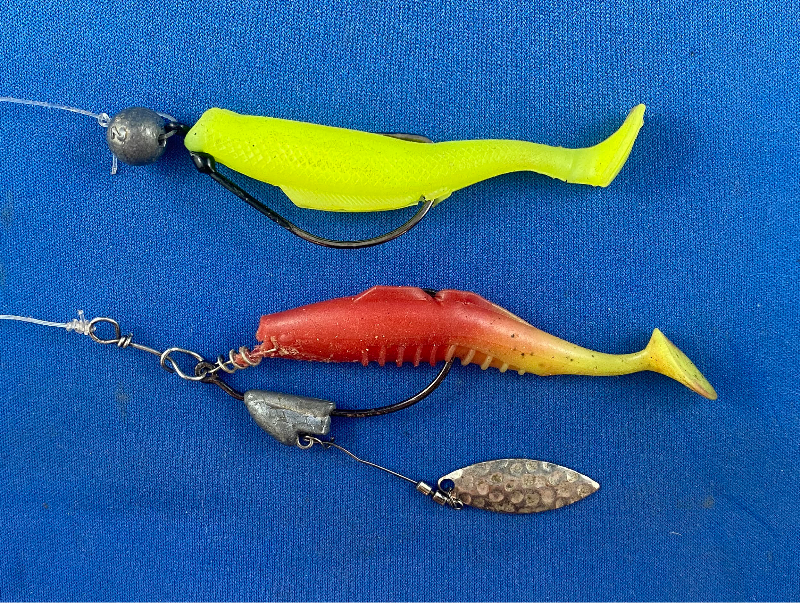
A weedless-rigged soft plastic incorporating a small ball sinker into the leader loop knot. Bottom: This softie on a flashy weedless rig has clearly seen some action.